Thursday, April 07, 2011

Tuesday, April 05, 2011

Julie Mehretu


Julie Mehretu, "Atlantic Wall", 2008-09. Ink and acrylic on canvas, 304.8 x 426.7 cm.
Commissioned by Deutsche Bank AG in consultation with the Solomon R. Guggenheim
Foundation for Deutsche Guggenheim


Chris Foss


Glenn Brown


The Tragic Conversion of Salvador Dali (after John Martin) (1998)

John Martin


The Destruction Of Sodom & Gomorrah (1852)

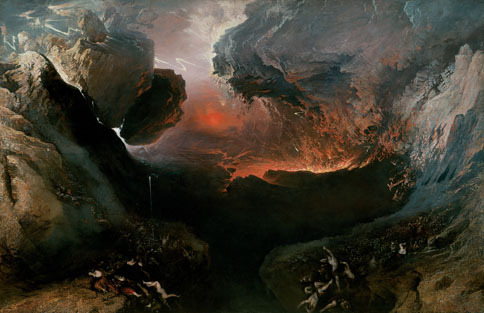
The Great Day of His Wrath (1851-1853)


Komar & Melamid, Scenes from the Future (1985)

Guggenheim
Museum of Modern Art

Pruitt-Igoe

Cyprien Gaillard, Dunepark (2009)

Tuesday, March 29, 2011

Teddy Cruz


Thanks to Adam Sharr for putting me on to Teddy Cruz.

See also:

Monday, February 21, 2011

The Unofficial Countryside


Not only was it a suprise to see a feature on Nick Papadimitriou on Newsnight last Thursday, there was the unexpected pleasure of seeing a short clip from Richard Mabey's 1975 TV programme The Unofficial Landscape.

Monday, January 17, 2011

The Sea in their Blood (1983)

I'm no fan of Peter Greenaway but this COI-commissioned documentary about Britain’s coastline is great.

Friday, January 07, 2011

William Bunge, Nuclear War Atlas (1982)


Bill Bunge's 1982 Nuclear War Atlas poster. From Martin Dodge's Cyber Badger Research Blog.

See D. Wood and J. Krygier, 'Maps and Protest,' in Rob Kitchin and Nigel Thrift, eds., International Encyclopedia of Human Geography (Amsterdam: Elsevier, 2009), pp. 438-9:

'[The map] folded, William Bunge, its principal author recalls, "into a 5 in x 8 in. size designed for peace demonstrations where it was abundantly sold." Black, white, and red, the very design and layout of the maps were inflammatory, but the reframing of data that had been culled from a variety of impeccably researched sources (e.g., Progress in Nuclear Energy, Health Physics, Child Psychology) was largely carried out by the titling: "The march of doom", "Patriotic poisoning", "The sea of cancer". "The sea of cancer" was a map of the U.S. largely covered with red stippling that indicated areas that would be exposed to 100 or more rem of radiation in a full nuclear war. "Not only will most of the United States be washed in immediate radiation," read the caption, "but even the white areas on the map are safe only in the sense that people in the open escape short term damage but not long term. The cancer is everywhere." A map of the world makes the point that the boundaries of a missile armed United States and Soviet Union are global: "To state the new geographic reality using the militaristic language of the 1980s, ‘The Russians are not coming. They are already here.’ At least they are straight up in the sky above us and thus are bounded by the earth’s surface, not ‘contained’ by boundary lines. They can kill anything on the earth’s surface and for a considerable depth below it; the Americans likewise. 'Containment' has been a mathematically proven bankruptcy for almost twenty years." By dramatically reframing simple truisms like these, The Nuclear War Atlas gave people whole new grounds for protesting nuclear weapons.'

Scene from the Other Side

Science Fiction in the Present 26 May 2011


26th May 2011 - Research Beehive, Newcastle University. A one day symposium organised by the School of Architecture, Planning and Landscape featuring the following speakers:
  • Noel Sharkey (University of Sheffield)
  • Stephen Graham (Newcastle University)
  • Mark Dorrian (Newcastle University)
  • David Cunningham (University of Westminster)
  • Matt Carr (Independent Scholar)
  • John Beck (Newcastle University)
  • Iain Boal (Birkbeck/Retort)
Attendance is free, places can be reserved by emailing anne.fry@ncl.ac.uk

Trevor Paglen: Blank Spots


Some snippets from Dirty Wars:

Planning the rescue of a kidnapped friend who has been squirreled away in a disused government installation, two men in Thomas Pynchon’s Vineland (1990) study maps of the area: “They peered at the maps, each with that enigmatic blank in the middle, like the outline of a state in a geography test, belonging to something called ‘the U.S.,’ but not the one they knew”  (250).

The unmarked space on the map has become a common trope in writing about the American West in recent years, a double motif that speaks on the one hand of the shroud of secrecy covering military-industrial activity and on the other the resistant spaces beyond the inventory of the U.S. standing-reserve.

In Terry Tempest Williams’ Refuge (1991), “A blank spot on the map translates into empty space, space devoid of people, a wasteland perfect for nerve gas, weteye bombs, and toxic waste” (241). Similarly, in DeLillo’s Underworld (1997), the white places on the map “include the air base, the army base, the missile range, the vast stretch to the northwest called the Jornada del Muerto and the interdunal flats as well.”  The flats themselves are perversely “map-white, on the page and in living fact,” so that their absence on the map does in fact represent their physical condition. In an uncanny twist, the blank space on this map tells the truth even as it continues to lie, since the few low buildings and propane tanks that are visible “service the underground operation in the Pocket, where weapons were conceived and designed” (404).

The blank space on the map is a visible marker of the state of exception that, as Giorgio Agamben explains in State of Exception (2005), “represents the inclusion and capture of a space that is neither outside nor inside (the space that corresponds to the annulled and suspended norm).”  The “topological structure” of the state of exception, claims Agamben, is “defined by the oxymoron ecstasy-belonging” (35); that is, being-outside yet also belonging.  This seems to me to be precisely the condition of the map’s blank spaces, which simultaneously refuse the function of the map’s signifying purpose while confirming this function: the blank space is where the hidden is emplotted, where the suspended norm gives shape to the normative representation of the world that surrounds it. The blank space is neither inside nor outside the nation state of the United States; it ruptures the continuous spatial indexing that produces the narrative sense of the map as a record of all there is while also indisputably being in that space.

The House in the Middle (1954)

'In the house on the right all the earmarks of untidy housekeeping...'

Producer: National Paint, Varnish and Lacquer Association
Sponsor: National Clean Up-Paint Up-Fix Up Bureau. Produced with the cooperation of the Federal Civil Defense Administration.

Thursday, January 06, 2011

Lost Landscapes of Detroit (2010)


Compilation of historical images of Detroit, Michigan (1917-1970), edited by Rick Prelinger for presentation at Museum of Contemporary Art Detroit (MOCAD) on February 10, 2010.

This movie is part of the collection: Prelinger Archives

Heavy Water: A Film for Chernobyl (2009)


The rest of this is available on Youtube. Or the DVD is available: Heavy Water: a film for Chernobyl

Friday, December 10, 2010

Wednesday, December 01, 2010

Steve Rowell, Playas, NM

Steve Rowell's Flickr Photostream, including shots taken during Steve's visiting fellowship at Newcastle University in June 2010.

Department of Homeland Security helicopters and student troops assault
empty homes during the inaugural simulation event in December 2004.
CLUI photo by Steve Rowell

Steve Rowell's Playas, NM work can be seen here.

Road to Las Vegas (2010)


Jason Massot, 'Road to Las Vegas: A Modern-Day Grapes of Wrath,' The Guardian

Monday, November 29, 2010

Monday, November 22, 2010

Detroit: Making it Better for You (2000)


Detroit: Making It Better for You from Kyong Park on Vimeo.


Text from Rethinking Marxism 15: 3, 404-5:

A project of International Center for Urban Ecology. Directed by Kyong Park. Composed, edited and narrated by Joshua Pearson [9:25min] 2000.

Detroit: Making It Better for You is a 2-channel video, showing a gritty tapestry of images on the destruction of Detroit, the city of the war between the sustainability of the local community against the greed of the global economy. Through its “driveby-shooting” technique—emblematic to the mythology of Detroit as the “Motor City”—the video offers street level views of the urban clashes between the inner city emptiness and suburban bliss.

Friday, November 19, 2010

Robinson in Ruins (2010)


  • Peter Bradshaw's review in The Guardian
  • Brian Dillon's piece on Keiller, also from The Guardian
  • Spotlight | Robinson in Ruins (Patrick Keiller, UK), Cinema Scope
  • 'The Future of Landscape: Patrick Keiller,' interview with Andrew Stevens in 3AM
  • Farihah Zaman, 'Home Fires,' Reverse Shot

Monday, November 15, 2010

Into Eternity (2010)


The focus of Michael Madsen's new documentary Into Eternity -- about the inconceivable task of securing nuclear waste deep underground for thousands of years -- is Onkalo in Finland. The Americans have a similar facility called the Waste Isolation Pilot Plant (WIPP) located near Carlsbad, New Mexico. Not least among the problems faced by designers of such places is how to signpost a site for curious visitors poking around the site in, say, 10,000 years time.
 
Landscape of Thorns, concept by Michael Brill and drawing by Safdar
Abidi, from Marking the Waste Isolation Pilot Plant for 10,000 Years


'Like the gaze of the exorcist, the gaze of the pollution-plagued contemporary is directed at something invisible. The risk society marks the dawning of a speculative age in everyday perception and thought. [...] Not until the step to cultural risk consciousness is everyday thought and imagination removed from its moorings in the world of the visible. In the struggle over risks of modernization we are no longer concerned with the specific value of that which appears to us in perception. What becomes the subject of controversy as to its degree of reality is instead what everyday consciousness does not see, and cannot perceive: radioactivity, pollutants and threats in the future' (Ulrich Beck, Risk Society 73)

Friday, October 08, 2010

Ballardian Architecture

Among the seemingly endless list of events I manage to miss is the symposium Ballardian Architecture: Inner and Outer Space, held at the Royal Academy of Arts on 15 May 2010. Fortunately, the organisers have posted a series of video clips of the talks. Click here for programme.


Ballardian Architecture 3 - David Cunningham from static tv on Vimeo.

Border Patrol Colouring Book

Public Collectors is a fantastic website where 'collectors allow the contents of their collection to be published and permit those who are curious to directly experience the objects in person.' One of the great finds here is a PDF of a colouring book for children produced by the U.S. Border Patrol Museum, El Paso, Texas. Can you help the detector dog find the illegal drugs? Click here and scroll down to find the complete book.