Two albums made at the beginning of the 1970s explicitly dealing with the reverberations of world war in the present. One by an English band, the other by a German group. Both draw on potentially controversial iconography and speak to particular constructions of national history and its legacies.

Wednesday, January 06, 2010
Miroslaw Balka: How It Is
Tate Modern 13 October 2009 – 5 April 2010.
For the second time in the same afternoon I am about to enter a dark Polish chamber. This time it is the vast grey steel shipping container erected in the Tate Modern’s Turbine Hall by Polish artist Miroslaw Balka entitled, after Samuel Beckett’s 1964 novel, How It Is. The huge box (30m long x 13m high) is on 2m stilts, which means that you can walk under it, though the feeling that the thing is going to collapse on top of you is quite strong. At the back end is a ramp which leads inside the structure but the darkness within is so profound that visitors soon completely disappear from view as they walk in. Although not quite as literal as Kusmirowski’s Wagon, a life size reproduction of the type of train carriages used to transport prisoners to Auschwitz exhibited at the 4th Berlin Biennale in 2006, allusions to recent Polish history in Balka’s work are clear. The size of the structure is such, though, that the echoes of forced transportation, imprisonment, and obliteration are both outstripped and amplified by the box’s overpowering presence.
Tuesday, January 05, 2010
Robert Kusmirowski: Bunker
The Curve, Barbican Art Gallery, London. 30.09.09-10.01.10

The Polish artist Robert Kusmirowski has bunkered The Curve -- the gallery has been converted into a series of rooms and corridors full of broken-down electronic equipment, discoloured documents, old clothes, and piles of old canisters. A draisine runs along a track that seems to go nowhere. Stair-rails are knobbled with rust and everything is covered in a heavy layer of dust. A ventilation system or electricity generator drone fills the space without ever becoming ominous, and some grilled lightbulbs provide just enough illumination to get from room to room.
The gallery attendant briefs me before I enter the bunker. It's quite dark in there, she says, so tread carefully. Don't touch anything. No photography. It is dark in there, in the way cinemas are dark when you go in during the day, or in the manner of a fairground attraction or waxwork exhibit where the creepy theatricality abruptly shuts out natural light and puffs its illusions into the atmosphere. It may just be a seasonal influence, but there is also a whiff of the grotto about the blank entrance to a subterranean world of fantasy. The disorienting effect is sudden in Bunker, and although the fact of the environment’s artifice never completely goes away, the Barbican complex within which the installation is ensconced seems immediately remote and irrelevant. More accurately, the experience is a bit like exiting a shopping mall into the stairwell of a multistory car park or mistakenly getting out of a lift on the maintenance floor. At moments like this, common enough in contemporary urban life, the glare and noise of heavily managed spectacular environments are temporarily cut out and we find ourselves amid the dirt, damp, and acoustic atonalities of the concrete boxes and sheet metal containers that are passed off as public space. This moment, on the threshold of entering Bunker, of anticipation and misrecognition is fleeting but key to the affective power of the kind of immersive environments constructed by Kusmirowski. It is the moment when the security of the art centre is imaginatively breached by the uncanny effect of finding oneself on the other side. Although it is the iconography of World War II and Cold War bunkers -- mid-twentieth century analogue technology, plenty of nuts and bolts, rust, concrete, and grey paint -- that Kusmirowski is drawing on to anchor the piece, the military dimension is downplayed enough for the space to feel like a more generic non-place, a forgotten or irrelevant corner of a large modern urban structure no longer even used by service staff. Walking around the outside of the Barbican in the dying light of a winter afternoon, the feeing is not that different.
- BBC News, Friday, 9 October 2009 Artist installs replica bunker

Wednesday, October 14, 2009
Take It then Face It
London Can Take It (1940), one of the most successful propaganda films produced in the UK during World War II, presents the chilling scenario of a city as target during total war. Directors Harry Watt and Humphrey Jennings used the American journalist Quentin Reynolds to write and narrate the voiceover, which to modern ears has the effect of making the opening of the film seem a bit like an episode of the Twilight Zone, where Rod Sterling introduces in earnest tones a drama of dreadful yet often plausible horror. This admittedly superficial resemblance to popular science fiction is not so far out, perhaps, since part of the purpose of Reynolds' narration is to provide critical transatlantic distance -- to speak to an American audience that is observing from far away, as if from another world -- and at the same time to carry the sense that what happens in London makes a difference in the United States. The film toured the US in a slightly modified form as Britain Can Take It, and President Roosevelt attended a private screening. The Blitz-torn London depicted here is a disturbing world that is all too familiar and yet morbidly strange; it is both reassuring and saturated with dread.
Thursday, October 08, 2009
Lightning Field
Will we see the lighting-flash of Being, in the essence of technology? The flash that comes out of stillness, as stillness itself?
-- Martin Heidegger (1)
Walter De Maria's Lightning Field (1977) is a one mile by one kilometer square grid of four hundred highly polished stainless steel poles. There are sixteen poles north to south, twenty-five poles east to west, placed 225 feet apart. Each pole is a different height to accommodate the variations in the terrain, ranging from 15.07 feet to 26.72 feet, so that their needle-pointed tops form an level plane. The Field is set on a flat plain in west central New Mexico, over seven thousand feet above seas level. It is an area that seasonally expects electric storms three days in thirty.
Unlike Smithson’s Spiral Jetty or Heizer’s Double Negative, which have been abandoned to the elements, Lighting Field is intended to be seen and the site maintained. A Depression-era cabin has been renovated to house visitors, who must book well in advance and are ferried to and from the site by employees based in Quemado (2). Stays are limited to one night. It takes about forty minutes to get to the Field from Quemado, a switchback ride along dirt roads without signposts that is more like being taken to some secret government installation than a well known art work. This is, of course, more or less what is happening (3).
No photography is allowed at the Lightning Field and camera equipment can be stored at the Quemado office. While this certainly reduces the proliferation of images of the work, which tend to be the oft reproduced, highly dramatic shots of a lightning bolt striking one of the poles, the main reason for the ban on picture-taking is more to do, it would seem, with discouraging visitors from wasting their time trying to photograph the thing. For, as De Maria well knows, the Lightning Field slips in and out of sight, the extent of its surface area is impossible to read by eye, and by the time one has moved back far enough to see the whole Field in its entirety, it hardly seems to be there at all. 'No photograph,' De Maria has written, 'group of photographs or other recorded images can completely represent The Lightning Field' (4).
The management of access and the banning of photography distinguish The Lightning Field among the major U.S. land art projects of the 1960s and 70s as uniquely restrictive. There is here, unlike at Spiral Jetty, Nancy Holt's Sun Tunnels, or Double Negative, a clear sense of ownership and control, even though the other sites are also the property of art world insiders (5). What also distinguishes the Field from these other works is its refusal to capitulate to the environment: the tips of the poles do comprise a level plane, regardless of the ground underneath. There is no erosion here; the poles are regularly polished. Yet while the restrictions may feel like a kind of Cold War frostiness -- this is New Mexico -- they are intended to serve the austere focus of the work and in a sense to protect it from being reduced to another tourist site on the trail. 'Isolation is the essence of land art,' writes De Maria, and the bareness of the land upon which the Field stands, along with the minimum of human contact and the divestment of the optical crutch of the camera as framing device, does strip away distraction and leave the work to stand as alone as it can be.
It is impossible not to look for symmetries and sight lines when viewing The Lightning Field. At the same time, it is impossible to see the whole work at once. From inside the Field, where De Maria says the 'primary experience takes place,' it soon becomes difficult to tell where you are within the grid and the poles appear to extend infinitely in all directions. In effect, it becomes an invisible labyrinth, the poles appearing to defy the known fact that they run in parallel lines and instead seem to be randomly scattered over the plain. They also appear and disappear according to light and position, two inch diameter reflective strips producing sharp curious creases in the vertical plane.
The night of our visit in 2002 was one of the three in thirty. By seven in the evening the sky has turned a dark gray-blue with rain on the horizon, and thunder rumbles in the distance. The cloud is very heavy and almost white with a steel-blue edge. Then there is a fantastic spike of lightning visible over the mountains. During the next hour the storm visibly moves toward the cabin, the lightning sometimes in light bulb pops, then as shooting shafts of crisp white light down the mountains. Twice, big flashes illuminate the Field and the rods stand out hard and impassive. As the rain falls heavily by 8 pm, all visibility is gone. It is, in fact, relatively rare for lightning to strike the poles -- 'The light is as important as the lightning,' claims De Maria -- but the Field's four hundred invitations do produce immense anticipation. As Kenneth Baker has observed, the lightning most likely to strike is 'psychological rather than metereological.' Baker sees the work as 'a device for coaxing into consciousness one's worst fears about the present moment and direction of history' while at the same time 'intensifying one's grasp of the beauty of the earth' (6).
Regardless of conditions, it is hard not to stand pensively before -- or within -- The Lightning Field. The site is that of an event, it is a place where something has happened or will at some unforeseeable point. The poles are like monitoring devices, antennae tuned to some inaudible frequency. Or they are themselves aligned to an invisible target in an unascertainable location, merely waiting to be activated. Or they are, more benignly, some sort of complex meteorological or electrical device for measuring air pressure, precipitation levels, electrical storms, wavelengths, electromagnetic pulses. Who knows? There is an undeniable temptation to imagine some undisclosed function, to project instrumentality onto these shafts of steel. It has something to do, undoubtedly, with their factory-turned perfection, the firm math of their grid, the purposeful way the Field appears to be waiting for something.
There is in The Lightning Field, claims Neville Wakefield, 'a hostility to nature manifest in the diffuse sadism of the sharpened poles, their highly polished surfaces and denial of topographical variance' (7). This may be a little strong, for although the poles do, perhaps, resemble weapons, they are also beckoning nature to come forth, drawing its electrical force back to earth through themselves as medium. And while indeed there is an assertion of mathematical regularity in the emplacement of the poles and a refusal to follow the contours of the land upon which they stand, this is not by definition a sign of hostility toward nature, although it does signal the ability of abstraction to override contingency. While the ground could have been levelled to allow poles of equal height to stand evenly, instead the height of the poles is adjusted to present a regular plane that sits invisibly above a ground that maintains its natural unevenness. There is a difference here, and it is the manufactured poles that have been manipulated, not the ground itself. The regularity of height is hard to see -- harder to see, I would imagine, than if the plain had been bulldozed to a perfect surface -- but it is there, a grid of polished tips embodying an abstract order of mathematical measurements that stands above the plain in a fashion similar to the way the grid of a map is laid over terrain but invisible from the ground. Of course, this is a rationalizing of space and does suggest an indifference to local modulations on the surface. Such an overlay does not in itself, however, constitute hostility to nature. It does, though, undoubtedly suggest a means of control and management, a way of dividing and regulating the amorphousness of land. It also demonstrates the strength of abstract systems: such a mathematical grid is infinitely extendable. All space can lie equally beneath its lines, which remain unperturbed by the irregularities of natural history. Part of the power of The Lightning Field, part of what makes the site pregnant with anticipation, is this way it reveals the power of mathematical and technological regulation and how such power intersects with, and is in tense dialogue with, forces of another order: mass, gravity, velocity, electricity.
1. Martin Heidegger, 'The Turning' (1949), in The Question Concerning Technology and Other Essays
 , trans. William Lovitt (New York: Harper & Row, 1977), p. 49.
2. When I asked the driver, Robert, how long he had been taking people to the site his answer was suitably taciturn: every day, May through October, for twenty-five years. De Maria has written that 'Part of the essential content of the work is the ratio of people to the space: a small number of people to a large amount of space.' Walter De Maria, 'The Lightning Field,' Artforum 18.8 (April 1980): 52-57.
3. Kenneth Baker claims that the work's suggestion of 'some sort of "big science" instrumentation whose function is obscured by unseen tiers of power' is 'eerily appropriate' since the DIA Foundation, which funded the work, obtained its resources 'from labyrinthine structures of international finance secured ultimately from military power.' Kenneth Baker, Minimalism
 (New York: Abbeyville, 1988), p. 127.
4. De Maria, 'The Lightning Field,' pp. 52-57.
5. Spiral Jetty is also owned by the DIA Foundation. The Museum of Modern Art, Los Angeles, owns Double Negative.
6. Baker, Minimalism, p. 127.
7. Neville Wakefield, 'Walter De Maria: Measure and Substance,' Flash Art 28. 182 (May–June 1995), pp. 91–94.
Monday, October 05, 2009


Thursday, September 01, 2005
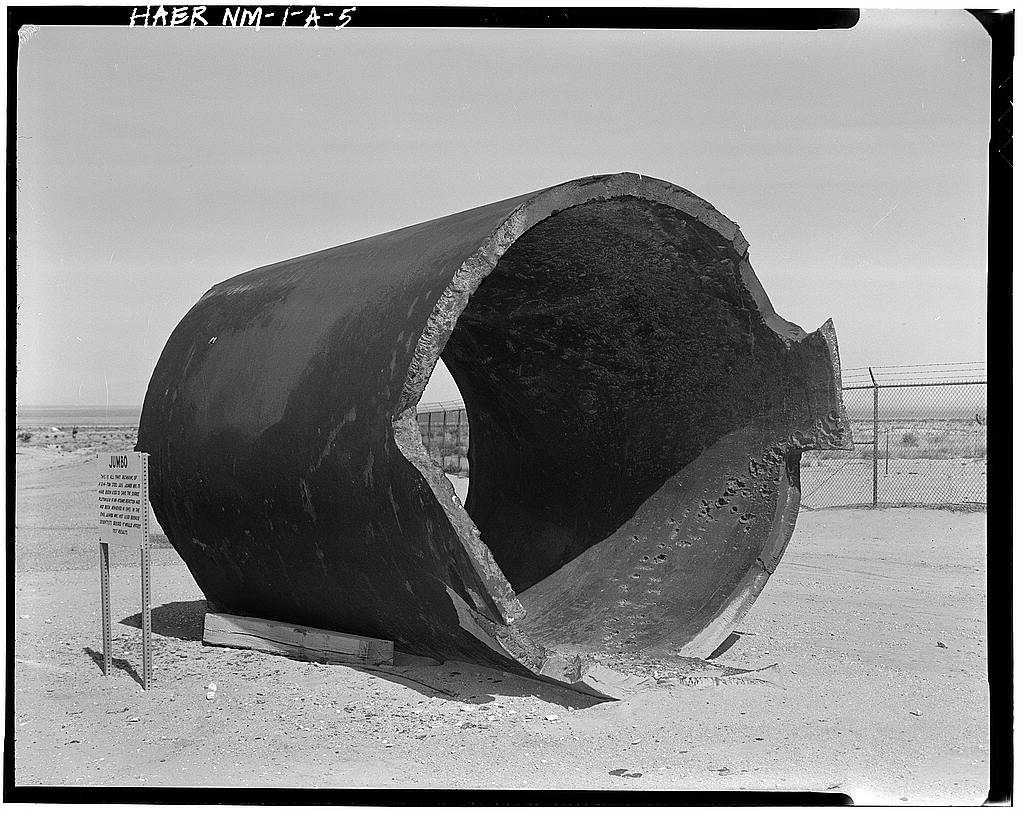
Trinity Site: Jumbo, View of Remains
‘[T]he archaeological refers to ruin and responses to it, to the mundane and quotidian articulated with grand historical scenarios, to materializations of the experience of history, material aura, senses of place and history, choices of what to keep and what to let go (remember/forget), the material artefact as allegorical, collections and their systems, the city and its material cultural capitalizations (investments in pasts and futures), the intimate connection between all this and a utopian frame of mind (archaeology is not just about the past, but about desired futures too). And the stuff of it all is garbage.’
Michael Shanks, David Platt, William L. Rathje, ‘The Perfume of Garbage: Modernity and the Archaeological,’ MODERNISM/Modernity 11.1 (2004): 61-83, p. 64.

Michael Shanks, David Platt, William L. Rathje, ‘The Perfume of Garbage: Modernity and the Archaeological,’ MODERNISM/Modernity 11.1 (2004): 61-83, p. 64.


Wendover Air Force Base, Tooele County, UT: War Reserve Strategic Storage
'Is there a deep similarity,' wondered cultural geographer John Brinckerhoff Jackson, 'between the way war organizes space and movement and the way the contemporary society organizes them.’ Perhaps, he goes on, ‘the military landscape and military society are […] both in essence intensified versions of the peacetime landscape, intensified and vitalized by one overriding purpose’ (1984: 135). Jackson is writing in the context of a discussion of his experiences as an intelligence officer during World War II, first at a training camp in Maryland and then in North Africa and Sicily as part of the 9th Infantry Division. What he learns in the army is to ‘think of the environment as a kind of setting or empty stage upon which certain alarming and unpredictable decisions and actions took place’ (132). While he is charged with gathering information on all aspects of the spatial organization of the areas through which the division will pass, this wealth of intelligence is, in the end, rarely used since any advance is preceded by saturation bombing that obliterates any roads, bridges, forests, fields or buildings before they arrive. Jackson’s point in this discussion is that despite the indifference of his superiors to his information gathering, he came to understand the value of intensive scrutiny of all aspects of a place and that through the result of asking ‘innumerable tactical questions’ a landscape can be understood as ‘part of a whole way of life’ where ‘an overall design was manifest in every detail’ (135).
What is most curious about Jackson’s argument is that he does not dwell on the military’s oblivious disregard for the particularities of environment but instead celebrates the discovery that close reading reveals that any landscape ‘has a style of its own’ that ‘can give an almost esthetic satisfaction’ (136). Almost inadvertently, though, Jackson does reveal the real extent to which the military organization of space, as an intensification of the ‘peacetime landscape,’ operates with no concern for what is on the ground unless it is of strategic benefit. What is also of no little significance here is how Jackson’s training in military geography produces knowledge in excess of strategic demands; inside military methods lies a possible means of dismantling the narrow instrumentalism that willfully ignores the results of its research.
Jackson, John Brinckerhoff (1984). Discovering the Vernacular Landscape. New Haven: Yale University Press.


Friday, July 01, 2005


Subscribe to:
Posts (Atom)