Monday, July 12, 2010

A Dry Porridge

Jean Arp, quoted in Rudolf Arnheim, Entropy and Art: An Essay on Order and Disorder (Berkeley: University of California Press, 1971), p. 54:

About 1930 the pictures torn by hand from paper came into being. Human work now seemed to me even less than piece-work. It seemed to me removed from life. Everything is approximate, less than approximate, for when more closely and sharply examined, the most perfect picture is a warty, threadbare approximation, a dry porridge, a dismal moon-crater landscape. What arrogance is concealed in perfection. Why struggle for precision, purity, when they Jean Arp can never be attained. The decay that begins immediately on completion of the work was now welcome to me. Dirty man with his dirty fingers points and daubs at a nuance in the picture. This spot is henceforth marked by sweat and grease. He breaks into wild enthusiasm and sprays the picture with spittle. A delicate paper collage of watercolor is lost. Dust and insects are also efficient in destruction. The light fades the colors. Sun and heat make blisters, disintegrate the paper, crack the paint, disintegrate the paint. The dampness creates mould. The work falls apart, dies. The dying of a picture no longer brought me to despair. I had made my pact with its passing, with its death, and now it was part of the picture for me. But death grew and ate up the picture and life. This dissolution must have been followed by the negation of au action. Form had become Unform, the Finite the Infinite, the Individual the Whole.

Dark Places

Exhibition at the John Hansard Gallery, University of Southampton, 24/11/2009 – 23/01/2010. More information on the exhibition available at Arts Catalyst and the Hansard Gallery site.

Monday, July 05, 2010

Edgar Lissel

German artist Edgar Lissel uses microorganisms to produce images in petri dishes, utilising the light-seeking behaviour of cyanobacteria as a photographic technique.

The series Bakterium – Wasser licht(et) Geschichte uses the Kilian submarine bunker in Kiel (now demolished) to consider the relationship between architecture, power, and ruins. The partially destroyed bunker is evident in the shapes emerging from the petri dishes.

The text below is from Lissel's website:

Bacterium

Bacteria - water light ( s ) history ( 1999/2000),
Bacterium - self portrayal (1999/2000) , and
Bacterium - Vanitas (2000/01 ).

All works of the three series are products of a special procedure, based on the property of certain bacteria to orientate themselves towards light. Using this dependency on light , bacterial cultures that were subjected Lissel kept in petri dishes filled with transparent agar solution to pictures. As a result darken , the bacteria grew and aligned themselves to the pictures in a way Comparable to photographic processes, where those spots on photographic paper that receive light, whereas those that are little exposed remain bright.

For bacteria - water light ( s ) history , photo negative were projected onto the bacterial cultures in classical photographic fashion. The pieces of the bacterium - Vanitas series, in contrast , are Comparable to photo grams : The objects were placed between the petri dish and the source of light , which was shining from below. The resulting images were then photographed and enlarged to about 80 cm ? (31.5 in.) . They reveal themselves in an ephemeral state, a fleeting moment in the organic cycle of growth and decay . Shadowy and fragile , they recall the early days of photography. They are also, however , products of the modern laboratory, documented and presented like a scientific experiment, in uniform shapes confined by the scientist's petri dishes.

For bacteria - self- portrayal, Lissel took microscopic pictures of the structures of single bacteria and projected onto petri dishes filled them with bacterial solution. As a consequence , the bacterial cultures reproduced their own micro -images . Normally indiscernible to the human eye, a multitude of organisms here can be observed creating a " super sign " of themselves , with their livelihood being a part of their self -portraits .

The series bacterium - water light ( s ) history comments on the potential transformation of architecture in ruins. As an example, Lissel used the submarine bunker " Kilian "in Kiel (which then stood in ruins, but was detonated later). The contours of the gigantic , partially destroyed bunker are vaguely visible. Some parts seem to drown in the water like a shipwreck , while others still stand tall , even if affected by decay , with somber , cave -like windows and concrete walls that seem to be several meters thick. The decline of the building counterposes with the gaining and fading of its symbolic representation in the petri dishes.

The transitoriness of all matter is a central theme of the third series , bacteria - Vanitas . Here Lissel employed classical still life motives such as fruit or animal corpses , whose disintegration is reflected in the petri dishes. The silhouettes of the bright objects are distinctly visible, yet one can also see that the bacteria started growing even in those places that received little light , such that they will eventually " outgrow "their own image. The representation fading away, however, symbolizes the coming death of the object itself.

In this complex field testing of references and counter-references , Lissel juxtaposes three time levels: first, there is the object which once existed but has since virtually dilapidated or decayed . The second level is that of the reproductions, of images that existed for a couple of days by means of bacterial movements , set up in a laboratory. The third one is created by photography, which captures those ephemeral moments and keeps them alive for a long time.


Wednesday, June 30, 2010

Tuesday, June 29, 2010

A Boy And His Dog (1975)


Post-apocalyptic Don Johnson. Is there any other kind? The whole film is on Youtube. Here is the first 10 minutes.


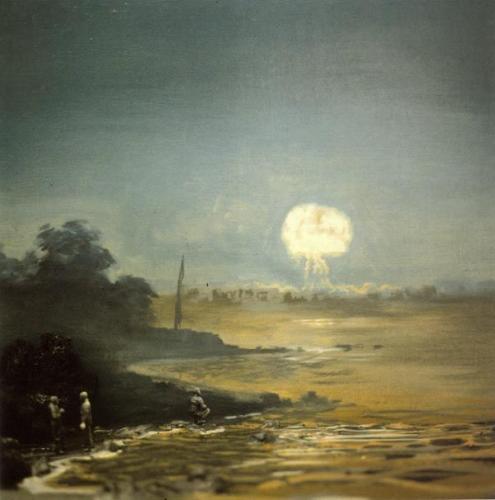
John Timberlake

Timberlake's Another Country series (2000-2003) is a disturbing mix of photography, painting, and model figures. The landscapes are familiar English paintings by the likes of Turner, Cozens and Constable. The nuclear clouds are copied from archival images of British nuclear tests.


Mark Klett

Mark Klett studied geology before working as a photographer with the U.S. Geological Survey. In the late 1970s, along with Ellen Manchester, JoAnn Verburg, Gordon Bushaw and Rick Dingus, he undertook the re-documentation of many places in the Western United States that had been photographed in the 19th century by territorial survey photographers such as Timothy O'Sullivan, William Henry Jackson and John Hillers. The Rephotographic Survey Project (RSP), as it was called, repeated over 120 19th century photographs between 1977 and 1979. In 1997 Klett and a new group undertook a new project, called Third View, which returned to many of the sites to make a set of third images. There is a great Third View website -- link is on the right.

I'm not sure of the provenance of the video below. This has only been up on Youtube since May 2010. The clips are accompanied by this text:

Mark Klett, a Regents Professor of Art at Arizona State University, and fellow photographer Byron Wolfe have spent three summers locating the sites of historic photographs and artworks of the Grand Canyon and making new photographs at the same locations.

These new photographs explore the relationship of the original images to the spaces they depict. The approach is intentionally experimental and playful, but the results are meant to explore the early art of the canyon and how the Grand Canyon landscape became one of American arts icons.


Monday, June 28, 2010

Bill Brown

Lakenheath and Mildenhall

United States Air Force information film prepared by Detachment 1, AETC Training Support Squadron, Lackland AFB, Texas, introducing the Lakenheath airbase and surrounding region.


Assignment Mildenhall, another information film for US air personnel.

Thursday, June 24, 2010

Jane & Louise Wilson

Sealander, The New Art Gallery Walsall, 14 December 2007 - 27 January 2008.

I missed this one completely. Here's what the Walsall gallery website says:

This exhibition, originally shown at Haunch of Venison in Zurich, consists of eight large-scale photographs and a multi-screen installation.

Black and white photographs show decayed, abandoned coastal bunkers. Though monolithic and compelling, these now useless edifices have become merely repositories for graffiti and litter, perhaps a place for shelter for local tramps. They occupy a place between land and sea. Though they carry the scars of battle, they now seem to defy any sense of time and place.

In the multi-screen installation, an exploration of the bunkers is inter-cut with footage of a rare deep sea squid, the Vampire Squid, which possesses the largest eye proportional to its body of any known creature. The eye of the squid seems to embody both the eye of the spectator and also of the camera as it moves constantly and fluidly through the sea or over the surfaces of the bunkers.

More information on this show, including installation views, can be found at the Haunch of Venison site. See also J.G. Ballard, 'A Handful of Dust,' The Guardian, Monday 20 March 2006, which is included in the Haunch of Venison catalogue for the show.


The vampire squid, according to the Sea and Sky website, 'is covered with light-producing organs called photophores. This gives the squid the unique ability to "turn itself on or off" at will through a chemical process known as bioluminescence. When the photophores are off, the squid is completely invisible in the dark waters where it lives. The squid has incredible control over these light organs. It has the ability to modulate the size and intensity of the photophores to create complex patterns that can be used to disorient predators and attract prey. The photophores are larger and more complex at the tips of the arms and the base of its two fins. Unlike most other squid, it does not have the ability to change its color. This ability would be useless in the dark environments in which it lives. The squid's light show is probably its main form of defense, since it lacks the ink sack which is present in other squid species. It can, however, eject a thick cloud of glowing, bioluminescent mucus from the tips of its arms when threatened.'

Tuesday, June 22, 2010

Saturday, June 05, 2010

Artavazd Pelechian


Plenty of other Pelechian films available at Ubuweb, including Our Century (1983).

Monday, May 31, 2010

Friday, May 28, 2010

Abo Elementary School and Fallout Shelter

Armoured Crab


German Mobile Steel Pillbox
See the Lone Sentry site for information.

Saturday, May 15, 2010

Tora Bora

Philip K. Dick

In Philip K. Dick’s The Penultimate Truth (1964), the outbreak of World War III prompts governments to bunker entire populations in huge underground shelters known as ‘ant tanks.’ As the war rages overhead, the subterranean masses are put to work manufacturing the robots that have replaced human combatants in the toxic conflict. Years pass, and the bunkered survivors watch on television as cities are incinerated and the president delivers morale-boosting messages that stress the need for increased productivity to meet the needs of the war effort. When a tank man burrows to the surface, however, he discovers that the war is long over and the robot armies his people have been building are in fact used as servants for a powerful conspiratorial elite that live in vast demesnes that have recovered from what was in fact a brief nuclear conflict. The destruction of cities and official bulletins are part of a global hoax, staged by those above ground to keep the earth free from its troglodyte hordes.

Friday, May 14, 2010

Disinformation: Blackout

W.G. Sebald

'Someone [...] ought to draw up a catalogue of types of buildings, listed in order of size, and it would be immediately obvious that domestic buildings of less than normal size -- the little cottage in the fields, the hermitage, the lock-keeper's lodge, the pavilion for viewing the landscape, the children's bothy in the garden -- are those that offer us at least a semblance of peace, whereas no one in his right mind could truthfully say that he liked a vast edifice such as the Palace of Justice on the old Gallows Hill in Brussels.'

W.G. Sebald, Austerlitz, trans. Anthea Bell (London: Penguin, 2002)